Bass is the one instrument where the simplest setup in your room can beat a fully miked studio cabinet. You have two real options: capture a direct signal through a DI, or put a microphone in front of a bass amp. Most records use both. Here is how to set up each one properly, and how to blend them into a low end that supports a mix instead of smothering it.
Start With a Direct Signal
A DI signal is your bass captured straight from the instrument, before any speaker or microphone colours it. It is clean, consistent and completely free of room problems, which is why almost every bass track you have ever heard has a DI underneath it somewhere.
Plugging in and setting levels
Plug your bass into a DI box or straight into a Hi-Z instrument input on your audio interface. Set the gain so your hardest notes peak around -12 dBFS. Bass has a huge dynamic range and a low note played hard can spike, so leave headroom.
Play for thirty seconds and watch the meter. If you are clipping on the loudest note, turn the interface gain down rather than the volume knob on the bass. Use the bass volume control only to change tone and feel, not to fix levels.
Getting the performance right
Recording bass at home succeeds or fails on timing, not gear. Play to a click even if you think you do not need one. Keep your attack even across strings, mute with the palm of your hand where notes overlap, and avoid letting open strings ring under phrases that should stop.
Record in sections rather than one heroic take. Two or three clean eight bar passes will beat a full song played shaky. If the song needs grit, dig in with a pick. If it needs weight, use fingers and play closer to the neck. That choice matters far more than which preamp you use.
One more thing: fresh strings sound bright and clicky on a direct signal, which can be useful for rock and annoying for everything else. Dead strings sit lower in a mix. Do not change strings the day of a session unless the song demands that snap.
Do You Need a DI Box?
Probably not at first. Most interfaces with a Hi-Z instrument input handle a bass on a cable up to about six metres without trouble. That said, a few situations make a DI box worth owning.
A transformer DI with a ground lift kills hum caused by ground loops between the amp and the computer. A passive DI lets you split the signal, so one output goes to your interface and the through output feeds your amp at the same time. And if you need a long cable run across the room, the balanced output of a DI carries much further before it picks up noise from power supplies and screens.
If your bass has active electronics, check for a pad switch. Active basses put out a hot, low impedance signal and can overload a sensitive input even with the gain right down.
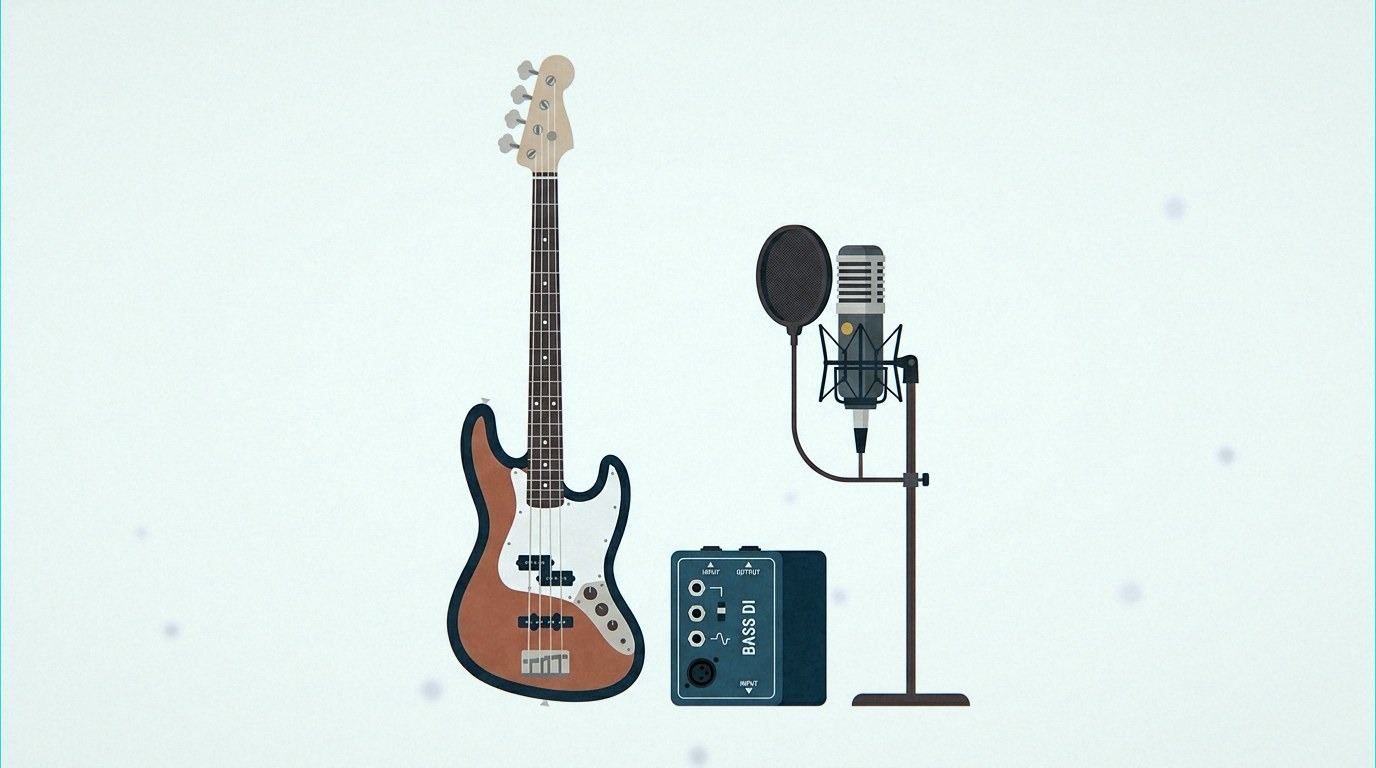
Miking a Bass Amp
If you want grit, midrange push and the sense of a real cabinet moving air, you need a microphone. Bass amp miking is not difficult, but low frequencies make the room more important than the mic.
Mic choice
A large dynamic mic designed for kick drum is the classic choice. It handles high sound pressure levels and has a low end lift built in. A standard dynamic workhorse gives more midrange bite, which is often exactly what a mix wants, since the deep lows are coming from your DI anyway. A condenser adds detail but picks up more of your room, so treat it as a second option in a small space.
Placement
Start three to five centimetres from the grille, pointed at the cone. Move toward the centre of the cone for more attack and brightness, and toward the edge for a rounder, darker sound. Angle the mic slightly off axis if the top end is harsh.
If you want more cabinet and less speaker, pull the mic back to 30 or 40 cm. That gives a more balanced, less pointillist picture at the cost of more room sound. In an untreated bedroom, close is usually safer.
Getting the amp to behave
Keep the amp off the floor, or put it on a decoupled stand or a thick rug. Half the boom you hear in a small room comes up through the floorboards. Keep the amp out of corners, which load up the low end hard.
Volume matters more than you think. A bass amp loud enough to feel in a live room will excite every standing wave in a bedroom. Set the amp at a moderate level, close mic it, and get the weight from your DI instead. Listen on headphones as you move the mic: small movements change the low end more than you expect.
Blending DI and Mic
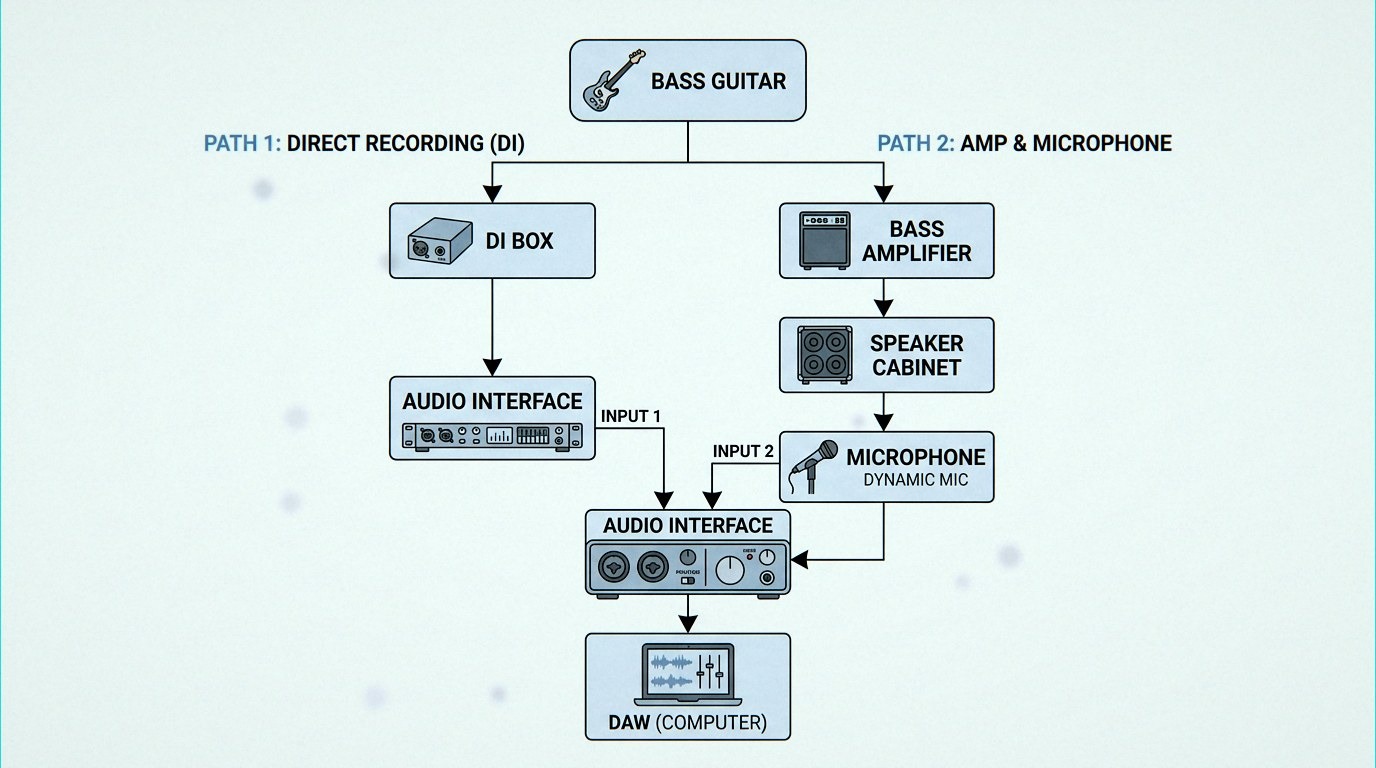
Record both at once. DI box through output to the amp, balanced output to the interface, and a mic on the cabinet into a second channel.
Then in your DAW:
- High-pass the mic track around 80 Hz. It has nothing useful down there and the DI covers that range better.
- Leave the DI full range, or gently low-pass it around 6 kHz to tame string noise and hiss.
- Start with the DI at 0 dB and bring the mic up until the bass gains definition, not volume.
- Flip the polarity on one track and listen. If the low end gets fatter with the flip, keep it. If it thins out, flip back.
- Nudge the mic track earlier in samples until it lines up with the DI. Aligning the two keeps the blend tight instead of smeared.
Check the blend in mono on a phone speaker. If the bass disappears, your mix depends on one source too heavily.
Editing and Tone Fixes Before Mixing
Clean up before you reach for plugins. Fade the top and tail of each take, cut noise between phrases, and listen at note level. A click or a lump of hum under a note will be obvious once compression hits it.
If the bass sounds woolly, the fix is usually a narrow cut somewhere between 150 and 400 Hz rather than adding treble. If it sounds thin, the problem is often that the DI is too clean and the mic is too quiet in the blend. Compression comes after editing, gentle, with a slow attack so the initial thump of each note survives.
Print or commit the blend once you are happy. One bass track is far easier to mix than four stacked alternatives.
Gear that helps
A well set up bass, one decent DI and one dynamic mic will cover almost everything in this article. If you want to move air rather than just capture a signal, a small combo or a head and cabinet makes amp miking practical at home, so take a look at our Bass Amplifiers range for compact options that record well at sensible volume. Everything else you can borrow, rent or simply do without until the songs demand it.