Buying your first MIDI keyboard usually comes down to one number that has nothing to do with sound: how many keys it has. Pick too few and you will hit the octave buttons every few seconds. Pick too many and you pay for range you never use, plus desk space you do not have. Here is how 25, 49 and 61 key models actually differ in daily use.
What key count changes and what it does not
Key count changes three things: the musical range you can play in one pass, the physical footprint, and how much the keyboard costs to build and ship.
It does not change sound quality. A budget 61-key controller and a premium 25-key controller both send the same MIDI data to your computer. The sounds come from your software. What separates them is the keybed, the feel of the keys under your fingers, and the controls around them.
The short version
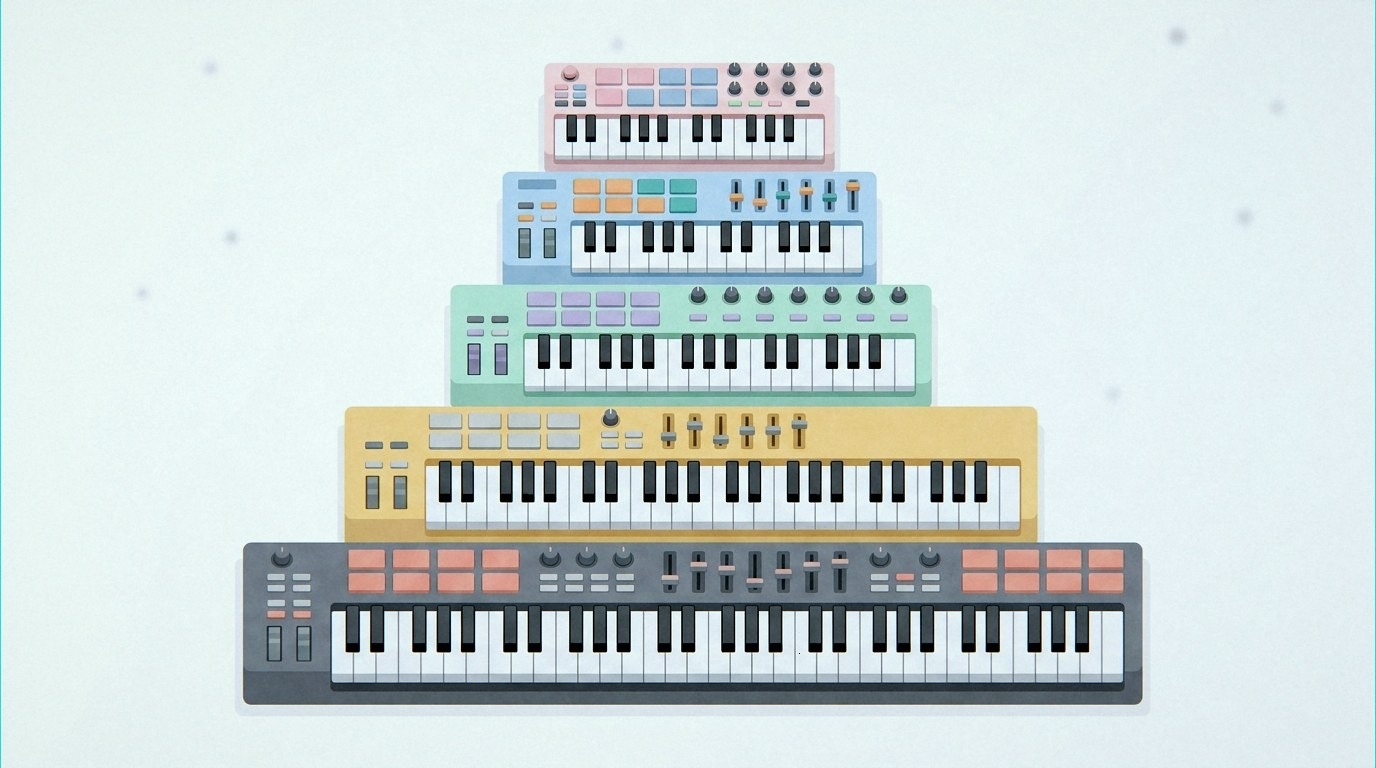
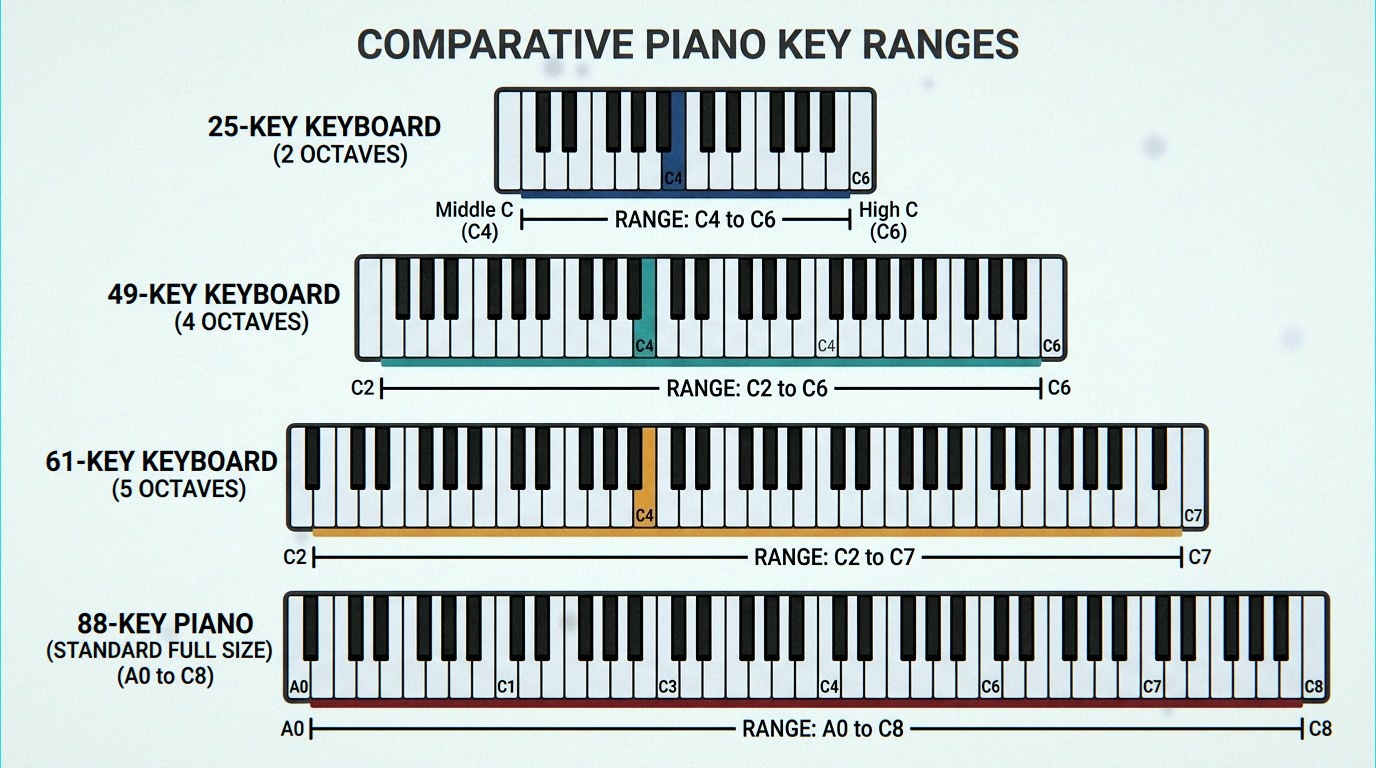
- 25 keys: two octaves. Sketching, beatmaking, travel, tiny desks.
- 49 keys: four octaves. The all-rounder for most production.
- 61 keys: five octaves. Piano-style parts, splits, two-handed playing.
25 keys, the pocket sketchpad
A 25-key controller is usually two octaves, C to C. That is enough for basslines, drum programming, single chords, and lead melodies that stay in one register. Because the layout is small, everything is within reach and the unit fits in a backpack.
The trade-off is constant octave shifting. If your chord progression jumps from a low F to a high G, you will press the octave button mid-phrase. That breaks the flow of performance, though it rarely matters if you draw most notes in the piano roll and only use the keys to audition ideas.
Who 25 keys suits
- Beatmakers and electronic producers who work mainly in the DAW grid.
- Anyone with a small desk, a laptop setup, or a need to travel.
- Players who want a second keyboard for live tweaking and filter sweeps.
If you never plan to play piano-style parts with two hands, 25 keys will not hold you back nearly as much as forums suggest.
49 keys, the balanced middle
49 keys gives you four octaves. That covers most chord voicings, bass plus melody, and the full range of typical pop, hip hop, house and film sketch work. It still fits on a standard desk and usually stays light enough to carry.
This is the size most producers end up keeping. You get genuine two-hand playing for simple parts, and the octave buttons handle the rest. Many 49-key models also include aftertouch, pitch and mod wheels, transport controls and DAW integration, so the size does not cost you features.
Where 49 keys runs out
Two-handed piano pieces with wide left-hand patterns will feel cramped. So will splits, where you assign bass to the left side and a lead to the right. If either of those is central to your playing, step up to 61.
61 keys, the piano-shaped choice
61 keys is five octaves, usually C to C. It is the closest you get to a real piano layout without jumping to 88 keys. Both hands can move freely, splits have room to breathe, and you can practise scales and repertoire without running out of range.
The cost is space and weight. A 61-key board takes up most of a desk and rarely fits in a bag built for a laptop. Also check the action: most 61-key MIDI controllers use synth-action keys, which are light and springy, not weighted like a piano. If weighted feel is your priority, look at an 88-key controller or a digital piano with USB MIDI.
Signs you need 61 keys
- You play two-handed piano arrangements, not just chords.
- You use splits and layers in live performance.
- You want to practise technique without hitting the octave button.
How to work around a smaller keyboard
You can stretch any size with a few techniques, and knowing them helps you buy smaller without regret.
- Octave shift: assign it to a foot pedal or a pad so your hands stay on the keys.
- Transpose: move the whole keyboard instead of your hands. Useful for covering a wide bassline.
- Scale and chord modes: many controllers lock to a key, so every note you hit fits the track.
- Splits and zones: on 49 and 61 key models you can send the lower half to one synth and the upper half to another.
These tools buy range, but they cost flow. Every shift is a small interruption. If you perform live and want zero interruptions, buy the size that matches your parts, not the size that fits your bag.
Matching size to your setup
Measure your desk before you buy, not after. Add space for a laptop, mouse and speakers. Then think about how you write.
If you compose in the piano roll and use the keyboard to audition sounds, 25 keys is plenty. If you play parts in by hand and want them to sound human, 49 is the safe default. If you sit down to play, not to program, go 61 or higher.
One last point: keybed quality matters more than key count. A 49-key controller with a responsive, comfortable keybed will serve you better than a 61-key board with stiff, noisy keys. Try before you buy where you can.
Gear that helps
If you are ready to pick a size, our MIDI keyboard range covers 25, 49 and 61 key controllers from the brands most producers trust. Pair one with a keyboard stand and you have a complete writing setup. Start with the size that matches how you play today, then upgrade when your parts demand more range.