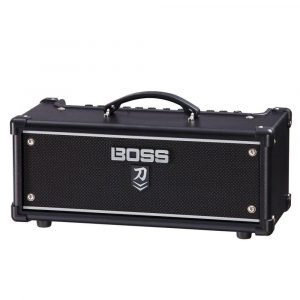
 Boss Katana-Head MKII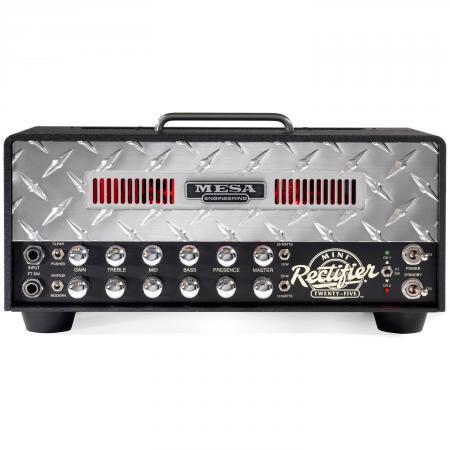
Description
Mesa Boogie has been long renowned for crafting some of the best guitar amps in the world. The new Mesa Boogie Mini Rectifier 25 guitar amp head is no exception. This amp packs a punch in a small package and is ideal for guitarists looking for high-quality sound and portability.
One of the most notable features of the Mesa Boogie Mini Rectifier 25 is its small size. Despite being a mini amp head, it still produces plenty of volume with its 25 watts of power. This makes it perfect for practicing at home, rehearsing with a band, or performing in small venues. The amp head weighs in at just 12 pounds, which allows for easy transportation without sacrificing sound quality.
The Mini Rectifier 25 features two channels, each with three different modes. This gives guitarists the ability to achieve a wide range of sounds without the need for additional pedals or effects. The clean channel is crisp and bright, and can be used for a variety of styles including jazz, blues, and rock. The lead channel offers a range of distortion levels, from mild overdrive to high-gain metal. The channel switching is done via a footswitch, adding to the convenience of the amp.
The EQ section on this Mesa Boogie amp head is extremely versatile. The channel-specific three-band EQ allows for precise control of each channel’s tone. Additionally, the amp features a global presence control, which can be used to fine-tune the amp’s overall tonal characteristics.
The Mini Rectifier 25 also features a built-in power attenuator. This allows guitarists to reduce the output power of the amp without sacrificing the amp’s tone. This is particularly useful for those who need to play at lower volumes but still want to achieve the sound of a cranked-up amp.
In terms of construction, the Mesa Boogie Mini Rectifier 25 is built to last. It is housed in a sturdy aluminum chassis that can withstand the rigors of gigging and touring. The amp is also built to Mesa Boogie’s high standards, ensuring that it will last for years to come.
In conclusion, the Mesa Boogie Mini Rectifier 25 guitar amp head is an excellent choice for guitarists looking for a high-quality, portable amp. With its versatile channels, powerful EQ section, and built-in power attenuator, this amp is sure to be a go-to choice for players of all styles. Whether you’re practicing at home or performing on stage, the Mesa Boogie Mini Rectifier 25 has you covered.
Mesa Boogie Mini Rectifier 25 properties
| Product name | Mini Rectifier 25 |
| Brand | Mesa Boogie |
| Type | Bass Amplifier Heads, Guitar Amplifier Heads |
| Sound Effects | Looper, Presence |
| Sound Setting | Gain/Drive, Middle, Treble |
| Features | Tuner for Instrument |
| Connection Inputs | Tele/TRS 6.3mm/1/4″ |
| Connection Outputs | Tele/TRS 6.3mm Single |
| Return/Send | Tele/RTS 6,3mm |
| Power Output (RMS) | 25.0 W |
| Amplifier Model | Tube |
| Colour | Grey |
| Power Supply | Electrical |
| Impedance | 16, 8 |


Beckett Moses –
Ah, there it is those golden days of yesteryear when the world wasn’t so preoccupied with algorithms and spreadsheets, but instead filled with the crackle of tubes, the hum of a pickup, and the soulful wail of a guitar amp in a dusty garage. During my recent trip to that sun-drenched corner of California, I found myself wandering through a small shop where the air smelled like nostalgia and the walls were lined with relics of eras past. It was there, amid the hum of a vintage Fender and the ghostly whisper of an old Marshall, that I felt the pull a siren song not for the latest trends but for something timeless. And so, on a whim (or perhaps a divine nudge), I purchased something that would later become my companion through late-night jam sessions and the occasional moment of existential doubt.
Now, let me be clear: I am no connoisseur of amplifiers, nor do I claim to speak for the gods of tone. But this thing this little box of magic (or was it a genie in a bottle?) it felt like meeting an old friend you hadn’t seen in decades. The way it responded to your touch, the way it could switch between tones as effortlessly as flipping through a well-worn record collection. It had that certain je ne sais quoi, the kind of warmth that made you forget the world outside your room existed. I’ve heard tales of other heads some grand, others minimalist but this one? It was like the universe had whispered to the designer and said, “Make it simple. Make it soulful.”
And here’s a peculiar twist: while I was indulging in my little pilgrimage to Oxnard (a place where even the economy seems to hum with the same rhythm as an old amp), I found myself pondering how online businesses have become this labyrinth of choices, each one vying for your attention like a band trying to get through a crowded club. It’s a world so different from the days when you’d walk into a store and the only thing on display was a single head, its voice waiting to be heard. Yet here we are sifting through reviews, specs, and endless options, all while wondering if the internet has made us more discerning or simply more confused.
Now, for those curious souls (and I do mean you, dear reader), let me digress a moment into a topic that’s been on my mind: the promise of solid oxide fuel cells. A recent article I stumbled upon ahem the promise of solid oxide fuel cells has got me thinking. There’s something poetic about energy systems that could power entire cities, yet here we are, still relying on the same old methods. Does it say anything about our relationship with technology? Or is it just another case of potential meeting reality in a dance that’s never quite perfect? I wonder if the future of sound and power might one day converge and what that would mean for those of us who live by the crackle of tubes and the warmth of analog.
I’ll be the first to admit: this thing is far from perfect. It doesn’t have all the bells and whistles, nor does it scream innovation in a way that would make a tech CEO weep with joy. But isn’t that what makes it special? In an age where everything must be loud, fast, and hyper-connected, there’s something comforting about the quiet revolution of simplicity. So here’s to all the producers past, present, and future who’ve spent their lives chasing that elusive sound, whether through tubes or fuel cells. May your amps never fail, your ideas never run dry, and your business models (online or otherwise) always find a way to adapt without losing their soul.
And if you’re wondering why I brought up that article about fuel cells? Well, isn’t it fascinating how the pursuit of clean energy mirrors our own quest for tone? Both are promises, both are challenges, and both remind us that progress is rarely about replacing the old it’s about building on what came before. Whether that’s a head with tubes or a cell with oxides, I say: to the future, and all its mysteries.