Your amp's EQ section is not a preset you dial once and forget. It is a small mixing desk, and the right settings only make sense in the context of the room, the band, and how loud you actually play. This guide covers what each control does, a dependable starting point, and the specific moves that help a bass cut through a busy mix.
Before You Touch a Single Knob
Set every EQ control on the amp to noon. That is your flat reference, even if the amp's noon is not perfectly flat in reality. Turn the volume and tone knobs on the bass itself all the way up, then roll the tone back only if you need to tame a bright instrument.
Next, set your playing volume roughly where it will be at the gig or rehearsal. EQ sounds completely different at bedroom level. A setting that feels warm at low volume often turns to mud once the drums arrive. If the amp has a gain control and a master volume, set gain so you get a little warmth or grit when you dig in, then use master for overall level.
Finally, stand where the audience or your bandmates hear you, not directly in front of the speaker cone. Bass wavelengths are long, and what hits your knees is not what fills the room. If the amp is on a hollow stage or a wooden floor, expect extra low end that you cannot hear from where you stand.
One more practical point: old dead strings have no high frequency content at all. No amount of treble boost will bring back definition that the strings no longer produce. If your tone sounds dull and lifeless, fresh strings are cheaper than a new amp.
What Each Control Actually Does
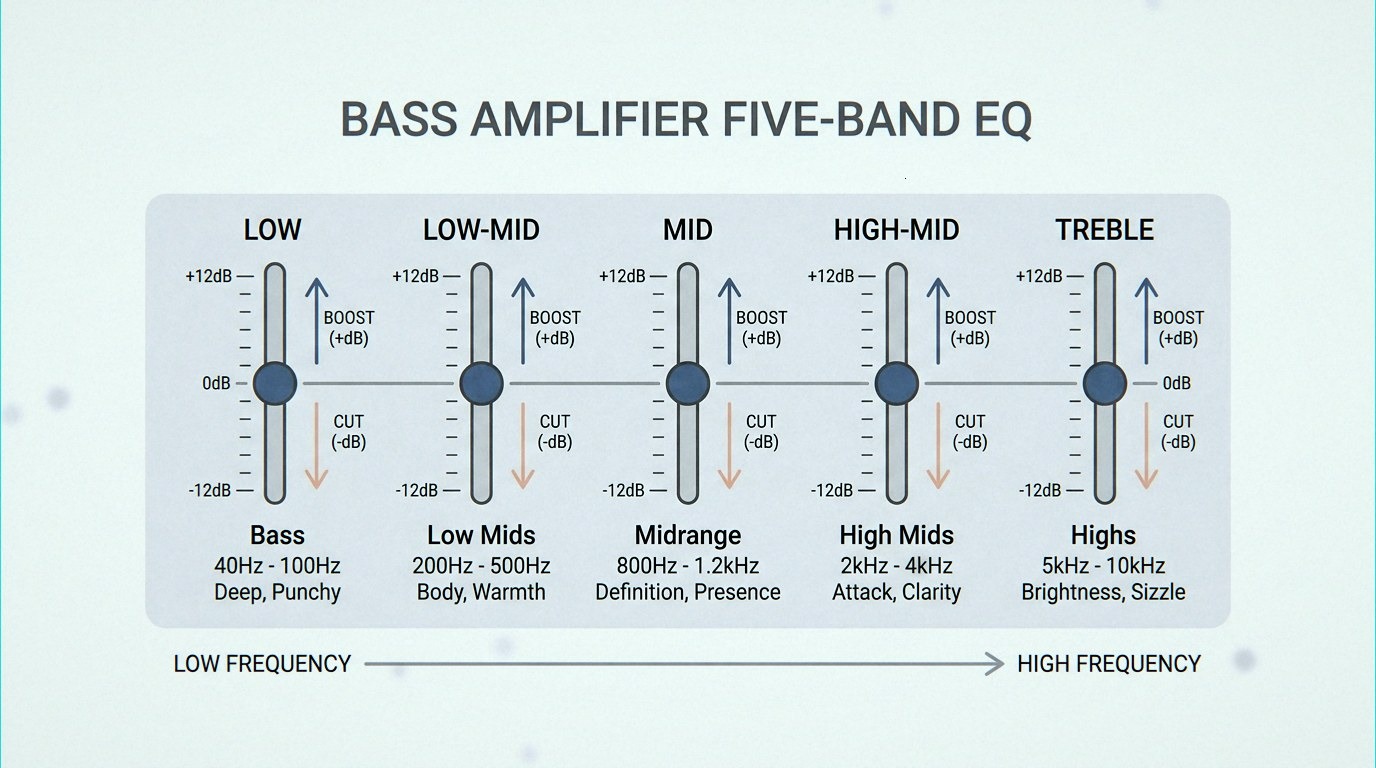
Bass (roughly 40 to 100 Hz)
This knob adds weight and rumble. It is the feel in your chest, not the note you hear. Small practice rooms and boxy stages usually need less of it than you think. Outdoors or in a large hall you will often want more. Too much bass eats amplifier headroom and makes the whole band sound slow.
Low Mids (roughly 150 to 400 Hz)
This is where your bass gets warm, thick and full. It is also the mud zone. Guitars, keyboards and the low end of the kick drum all live close by, so a small cut here is the single most common fix for a bass that sounds like a blanket is over the speaker.
High Mids (roughly 600 Hz to 2 kHz)
This is the definition range. Finger noise, pick attack, fret clank and the growl of a good bass all sit here. If your bass disappears the moment the rest of the band starts playing, this is the knob to reach for. A little goes a long way.
Treble (roughly 3 kHz and up)
Treble gives you string zing, snap and fretboard detail. It is also where hiss, finger squeak and harsh clank live. On amps with a tweeter or horn, the treble knob and the horn level control work together, so adjust both.
The knobs that are not EQ
Contour, shape or preset buttons usually scoop the mids, which sounds great alone and terrible in a band. Compression evens out your dynamics and helps you sit consistently in the mix. A mute or tuner out is not tone, but it will save your life on stage.
A Reliable Starting Point
Use this as a launch pad, then adjust by ear.
- Start flat. All amp EQ at noon, bass volume and tone wide open.
- Set your performance volume first. Do not chase tone at low level.
- Add bass slowly until the low end feels full, then back off a touch. Most players overshoot here.
- If the sound is thick and unclear, cut low mids by 2 to 4 dB. If it is hollow, add a little.
- Add a small amount of high mids, around 3 dB, for definition.
- Set treble last, just enough for attack and string detail without hiss.
- Walk the room. If it sounds good ten feet away and bad at the amp, trust the ten feet.
Write the numbers down or photograph the panel. When you load in at a new venue, you will be starting from something known instead of guessing.
Cutting Through the Mix
This is where most bass players go wrong. They turn up, add bass, and end up fighting the kick drum for the same low frequency space while the guitars bury the notes they are actually playing.
The secret is midrange. The human ear is most sensitive between roughly 1 kHz and 4 kHz, and that is also the range where a bass note's pitch becomes obvious. Your job is to claim a slot and stay in it.
- Cut rather than boost when you can. A small cut around 250 to 400 Hz on the bass amp creates room for the kick and the guitars and makes your own mids sound louder.
- Own a narrow band. Somewhere between 700 Hz and 1.5 kHz is usually the sweet spot for bass presence.
- If the kick drum is dominating the sub range below 80 Hz, roll a little bass off and let the drums have it.
- If the guitars are thick and mid heavy, aim slightly higher, around 1.5 to 2 kHz.
- Never scoop the mids with a contour button and then turn up to compensate. That is a volume war you cannot win.
A little compression also helps enormously here. It keeps your quiet notes audible and stops your loud notes from jumping out and getting the whole band turned down by the sound engineer.
Fixing the Usual Tone Problems
The sound is muddy
Cut 200 to 400 Hz by 2 to 4 dB, reduce the bass knob slightly, and get the amp off the floor or away from a corner. Walls and floors add low end you did not ask for.
The sound is thin and has no weight
Add low mids around 150 to 250 Hz, raise the bass knob a little, and reduce treble. Check that your bass's own tone knob is not rolled off in a strange way, and check that the pickup blend is centered rather than fully on the bridge pickup.
The sound is harsh and clanky
Cut treble by a couple of dB, drop the tweeter or horn level if the amp has one, and back off the high mid boost. Often the problem is technique plus too much 2 to 4 kHz.
It disappears as soon as the band plays
Boost high mids, cut a little low bass to free up headroom, and check your position relative to the drummer. Two bass sources in the same corner never work.
It sounds different at every venue
That is normal. Small boomy rooms want less bass and more low mid cut. Big open spaces want more bass and a bit more treble to carry. Keep a note of what you changed each time and you will start solving rooms in seconds.
Gear that helps
A head with a real midrange control, or better still a semi-parametric one, makes everything in this article far easier to dial in. If you are shopping, browse our bass amplifiers for combos and heads with usable EQ, and look for a cabinet with a switchable tweeter so you can fine tune the top end without touching the amp.