Every instrument with black and white keys looks roughly the same from three metres away, and that is exactly why so many people buy the wrong one. The difference is not quality or price bracket, it is what the instrument is built to do. Here is how to tell the three families apart and pick the one that fits how you actually play.
The three families, and what each one is for
Digital keyboards and arranger keyboards
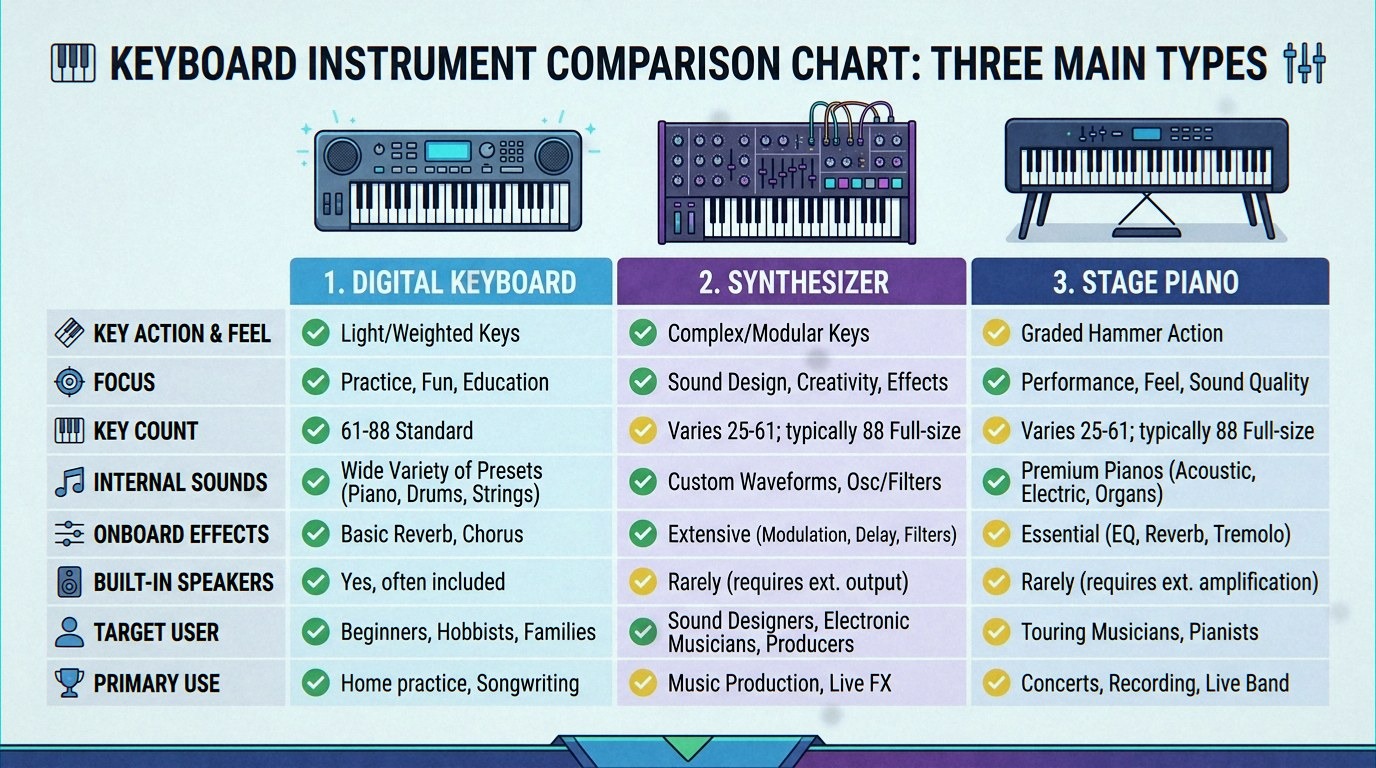
A digital keyboard is a self-contained instrument. Press one key and you get a piano, an organ, a string pad or a saxophone. Switch on the rhythm section and you get a drummer, a bass player and a backing band that follow your left hand.
An arranger keyboard is the most feature-packed version of this idea. It reads the chords you play and generates a full accompaniment in the style you choose, with intro, fill and ending buttons. If you play solo at a wedding, lead a singalong, or just want to sound like a whole band in your bedroom, an arranger is the tool built for that job. Expect 61 keys, built-in speakers, hundreds of sounds and a light, springy action.
Synthesizers
A synthesizer exists to make sounds that did not exist before you made them. Instead of preset pianos you get oscillators, filters, envelopes and modulation routing. You turn a cut-off knob and the sound changes character in real time.
Synths are not trying to imitate a grand piano. They are for producers, electronic players and anyone who wants to design a bass, a lead or a texture from scratch. Expect fewer keys, no speakers, and a lot of knobs. Analog, virtual analog, FM and wavetable are the main flavours, and each one sounds and behaves differently.
Stage pianos
A stage piano is a piano first and a computer second. The priority is the feel of the keys and the accuracy of the piano sound. You get 88 weighted, hammer-action keys, a small number of very good sounds, a solid chassis and clean outputs for a PA. No auto accompaniment, usually no speakers, sometimes no screen worth mentioning.
If your playing is piano playing, and you need it to travel, this is the category. The action is the whole point: a weighted keybed lets you build dynamics with your fingers instead of a volume knob.
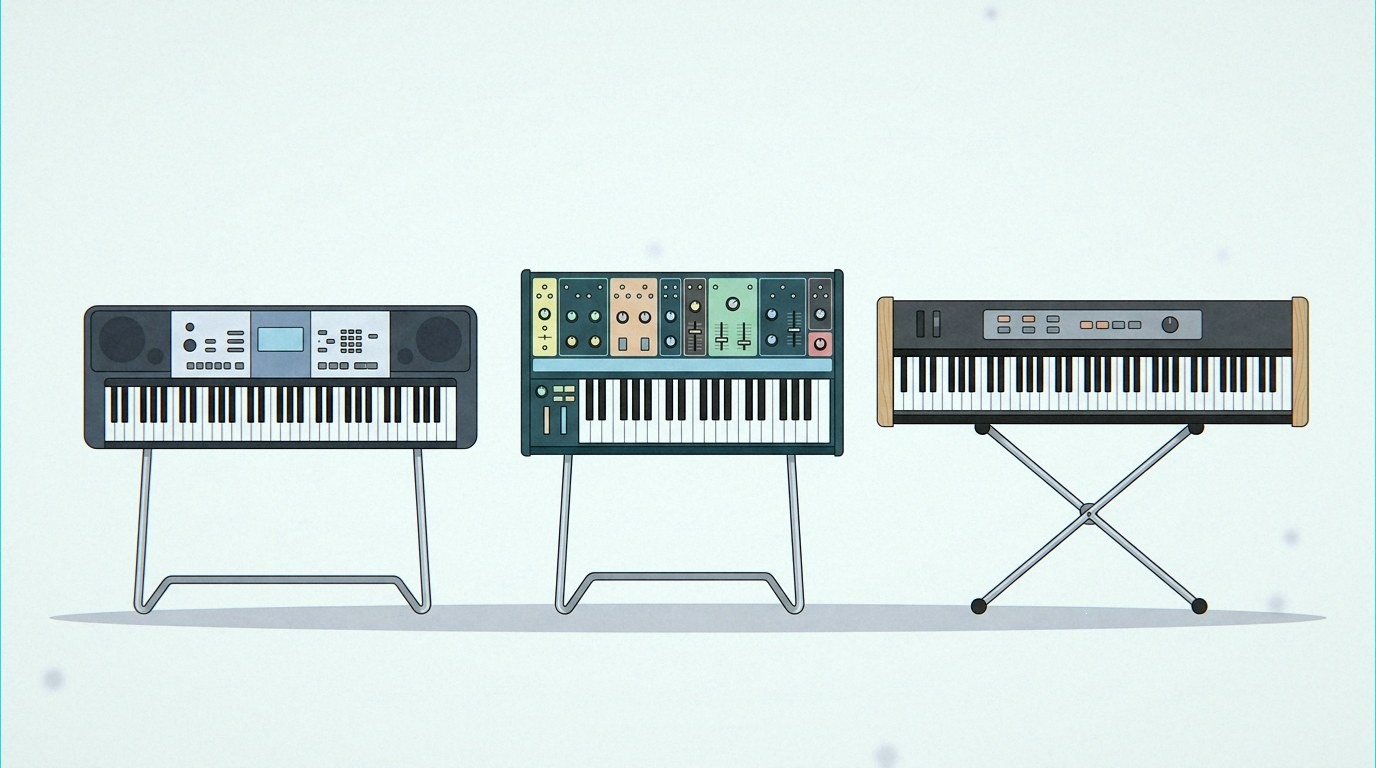
Keyboard vs synthesizer, in one paragraph
The word keyboard describes the interface, the black and white keys themselves. A synthesizer describes the engine underneath. Every synth has some kind of keyboard or controller surface, but not every keyboard is a synth, because plenty of them play back samples rather than generating waveforms. The practical question is whether you want to play sounds or build them.
Stage piano vs keyboard, in one paragraph
Same logic, different axis. A stage piano gives you fewer sounds at higher quality with a heavier, more realistic action. A digital or arranger keyboard gives you dozens or hundreds of sounds with a lighter action, built-in speakers and automatic accompaniment. One is a piano you carry. The other is a small orchestra you carry.
Six questions that decide it for you
Do you play alone and want a full arrangement?
Arranger keyboard. Nothing else does this at the price.
Do you already play piano and need it to feel like a piano?
Stage piano. Try the keybed before you buy, because action preferences are personal and a heavy action gets tiring if you are not used to it.
Do you want to create sounds, not just play them?
Synthesizer. Start with a virtual analog or wavetable synth that has plenty of hands-on controls rather than a menu-heavy unit you will never program.
Do you work mostly in a DAW?
A MIDI keyboard plus software is cheaper and more flexible, but remember it makes no sound on its own.
Do you gig?
Weight matters. A 61-key arranger at 6 kg is a different evening from an 88-key stage piano at 18 kg. Check the stand, the bag and the outputs before you fall in love with the sound.
How many keys?
61 keys covers most pop, rock and electronic playing. 76 is a comfortable middle. 88 is for serious piano repertoire, and it means a bigger, heavier instrument.
Features worth checking before you pay
- Polyphony. 64 notes is fine, 128 is comfortable, and anything below 32 will drop notes when you hold the sustain pedal.
- Action type. Synth action is light and springy, semi-weighted sits between, hammer action imitates a real piano.
- Speakers. Built-in speakers are great at home and useless on a loud stage.
- Connectivity. USB MIDI, a sustain pedal jack, line outputs and a headphone socket should all be present. Bluetooth audio is a bonus, not a reason to pay extra.
- Sound editing depth. If a synth has no knobs, you will not edit it, and if you do not edit it, you have bought a keyboard.
Budget guide
Entry level, roughly 200 to 450: a home arranger keyboard or a basic MIDI controller. Fine for learning, limited for gigging.
Mid range, roughly 450 to 900: a better arranger with stronger speakers and rhythms, an entry stage piano, or a small synth with real controls. This is the sweet spot for most beginners and returning players.
Upper range, 900 and up: proper hammer-action stage pianos, polysynths with serious engines. Buy here when you know exactly what you are missing, not before.
Gear that helps
If you want one instrument that plays a whole arrangement by itself, start with our digital keyboards and arranger keyboards. If you already work in a DAW or want to drive software synths, a MIDI keyboard and controller is the cheaper, more flexible route. Either way, ask yourself what the instrument has to do on a normal Tuesday evening, and buy for that.