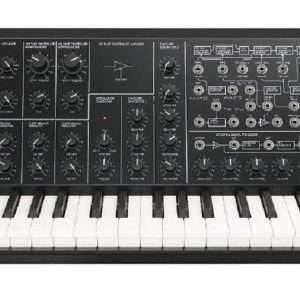
 Korg MS-20 Mini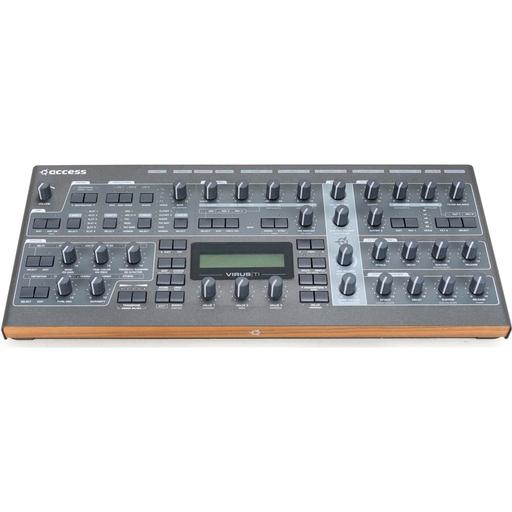
Description
The Access Virus TI2 Desktop Synthesizer is a powerful digital beast that has stood the test of time. It is widely considered one of the most advanced synthesizers of its kind, with cutting-edge features, pristine sound quality, and an intuitive user interface that makes it easy to use.
One of the standout features of the Virus TI2 Desktop Synthesizer is its sound engine. It boasts over 80 oscillators, with up to 16 voices of polyphony, which makes it capable of producing everything from classic analog synth sounds to modern, complex soundscapes. It also has a variety of filter types, including low-pass, high-pass, bandpass, and more.
Another impressive feature of the Virus TI2 Desktop Synthesizer is its modulation capabilities. It has three LFOs, two ADSR envelopes, and an extensive modulation matrix that allows you to route any modulation source to any destination. This gives you incredible flexibility and control over your sound.
In terms of connectivity, the Virus TI2 Desktop Synthesizer has everything you need to integrate it into your studio setup. It has a variety of inputs and outputs, including MIDI, USB, and audio inputs and outputs. It also has a built-in USB audio interface, which makes it easy to record directly into your DAW.
One of the unique aspects of the Virus TI2 Desktop Synthesizer is its VirusControl VST/AU plugin. This allows you to use the Virus as a hardware synth, but with the added convenience of being able to control it directly from your DAW. All of the synth’s parameters can be easily accessed and automated, making it a breeze to integrate into your production workflow.
Overall, the Access Virus TI2 Desktop Synthesizer is a powerful and versatile synth that is sure to impress even the most demanding producers and synth enthusiasts. Its advanced sound engine, modulation capabilities, and intuitive user interface make it a joy to use, and its robust connectivity options and VirusControl VST/AU plugin make it a versatile addition to any studio setup. If you’re looking for a top-of-the-line synthesizer, the Virus TI2 Desktop Synthesizer is definitely worth considering.
Access Virus TI2 Desktop properties
| Product name | Access Virus TI2 Desktop |
| Brand | Access |
| Type | Synthesizers |
| Keys | No |
| Drawbars/Sliders | No |
| Pads | No |
| Rotary Controls | No |
| Modulation Wheel | Yes |
| Pre-Programmed Rythms | No |
| Pre-Programmed Songs | No |
| Pre-Programmed Sounds | No |
| Pre-Programmed Drumset | No |
| Pre-Programmed Effects | Yes |
| Built-In Tuner | No |
| Portable | No |
| Speakers | No |
| Connections | 3.5mm (AUX), 6.3mm (1/4″RTS), Headphone, MIDI Through USB |
| Colour | Black |
| Power Supply | Electrical Cable to Wall Socket |
Benjamin –
I’m sorry if my initial thoughts came across as overly critical I truly meant to approach this with curiosity, not judgment. After purchasing what I believed was a groundbreaking desktop synthesizer from an online shop, my experience was… mixed. The device arrived with promise, but its performance left me puzzled. The pads, which are central to many synthesis workflows, felt oddly disconnected from the core sound engine. They lacked the tactile responsiveness and precision I’d hoped for, making nuanced modulation feel like a game of chance rather than artistry.
What intrigued me was the synth’s architecture its ability to blend analog warmth with digital flexibility in ways that few others attempt. The oscillators seemed capable of producing textures that could morph between organic and synthetic tones, but this potential felt stifled by the pads’ limitations. It made me wonder: Could a redesign of the physical interface unlock new possibilities for sound design? Or is there a deeper technical barrier here, like an unbalanced signal path or insufficient velocity sensitivity?
Today’s news about a breakthrough in sensor technology for musical instruments made me pause could this be a sign that such limitations are no longer insurmountable? I apologize if my rating feels harsh; I’m simply trying to explore where this device might fall short, while still acknowledging the ingenuity behind its design. It’s a reminder that even the most innovative tools need refinement to fully realize their potential and perhaps, there’s more to discover here than I initially noticed.