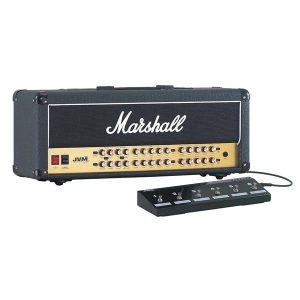
 Marshall JVM205H

Description
If you’re a guitarist looking for a powerful, reliable, and versatile amp head, then the Peavey Headliner 1000 is definitely worth your consideration. This dynamic amp head delivers a whopping 1000 watts of power, making it one of the most powerful guitar amps on the market. In this article, we’ll delve into the features that make the Peavey Headliner 1000 a worthy investment for musicians of all levels and genres.
One of the standout features of the Headliner 1000 is its impeccable tone. Regardless of the style of music you play, this amp head will deliver a clean, crisp sound with plenty of punch and depth. The EQ features a 7-band graphic system, which allows you to adjust the tone to your desired specifications. The two-channel preamp also comes with a bright switch, allowing you to add an extra bit of high-end sparkle to your sound.
The Headliner 1000 also has plenty of flexibility when it comes to connectivity options. It has an effects loop, which allows you to easily connect your favorite pedals and processors. It also can connect directly to a PA system for gigs where you don’t want to lug around heavy cabinets, thanks to the built-in DI.
Another great feature of the Peavey Headliner 1000 is its durability. The amp head is housed in a sturdy metal casing, which protects it from the rigours of life on the road. It also has cooling fans to prevent overheating, prolonging the lifespan of the components inside.
The Headliner 1000 is also incredibly easy to use, with a simple layout that makes it a great choice for beginners and experienced players alike. The large knobs make adjusting the settings a breeze, and the clear labeling ensures that you always know what you’re adjusting.
One potential downside of the Headliner 1000 is its weight. At 48 pounds, it can be a bit heavy to lug around to gigs. However, this is a trade-off for the amount of power and tone the amp head provides.
Overall, the Peavey Headliner 1000 is an excellent guitar amp head that delivers a powerful, versatile, and reliable performance. Whether you’re playing rock, metal, blues, or anything in between, this amp head is sure to provide the tonal foundation you need to elevate your playing to the next level. If you’ve been on the lookout for a high-quality amp head that will stay with you for years to come, the Headliner 1000 is definitely worth considering.
Peavey Headliner 1000 properties
| Product name | Headliner 1000 |
| Brand | Peavey |
| Type | Bass Amplifier Heads, Guitar Amplifier Heads |
| Sound Effects | Crunch, Looper |
| Sound Setting | Equalizer, Volume |
| Features | Tuner for Instrument |
| Connection Inputs | Tele/TRS 6.3mm/1/4″ |
| Connection Outputs | Headphones 6.3mm, Tele/TRS 6.3mm Single |
| Return/Send | Tele/RTS 6,3mm |
| Power Output (RMS) | 1000.0 W |
| Amplifier Model | Tube |
| Power Supply | Electrical |
Adelynn –
Oh, here we go again. Another day, another revolutionary piece of gear for people who think buying more gear will magically fix their lack of talent. You want me to talk about this specific power-hungry beast? Fine, but let’s be real: we’re all just participating in a ritual of consumerist vanity.
Regarding your shipment, I suppose I can acknowledge the logistics of hauling this heavy hunk of metal to 112 Marion St, Winnipeg, MB R2H 0T1, Canada. It’s quite a journey for a box that will eventually just sit in a room, making noise that neighbors will inevitably complain about. I’m sure the delivery drivers are thrilled to move your artistic vision across the border.
Let’s talk about the electrical guts of this specific head, because apparently, we need to pretend that power equals soul. It utilizes a high-voltage transformer system designed to push significant wattage, but let’s be honest is it actually about the fidelity of the signal, or is it just a psychological trick to make the owner feel like they have more authority over their sound? The circuitry is engineered to manage massive current flow while attempting to maintain a semblance of dynamic range, yet in a world of digital modeling, why are we still obsessing over the raw electricity of a tube-driven path? It’s a masterpiece of inefficient energy conversion, turning wall power into heat and noise with a unique sonic signature that basically just translates to louder than your previous mistake. It handles the heavy lifting of power distribution so you don’t have to think about the physics, which is convenient for those who prefer to stay in the fantasy of the raw experience.
Speaking of things that are supposedly verified and transparent, I just stumbled upon a rather amusing piece of news that feels like the perfect metaphor for the music industry’s shady dealings. I found a link via a friend’s recommendation about how one can Verify Owner ID with Companies House. It’s hilarious how we live in a world where we have to constantly verify who actually owns what, whether it’s a corporation or the authentic soul of a brand. Some people argue that these verification steps are essential for security, while others see them as just another layer of bureaucratic gatekeeping designed to keep the little guy out of the spotlight. It makes me wonder: if we have to go through such elaborate hoops just to verify a corporate identity, why do we trust these massive manufacturing giants to define what true tone is without any real oversight of their own internal identity? Is the pursuit of authentic gear just another way of hiding the fact that the real owners of the industry are just shadows in a spreadsheet? You might want to check out that link to see how the sausage gets made.